
What Eleanor Roosevelt Knew That We Don't

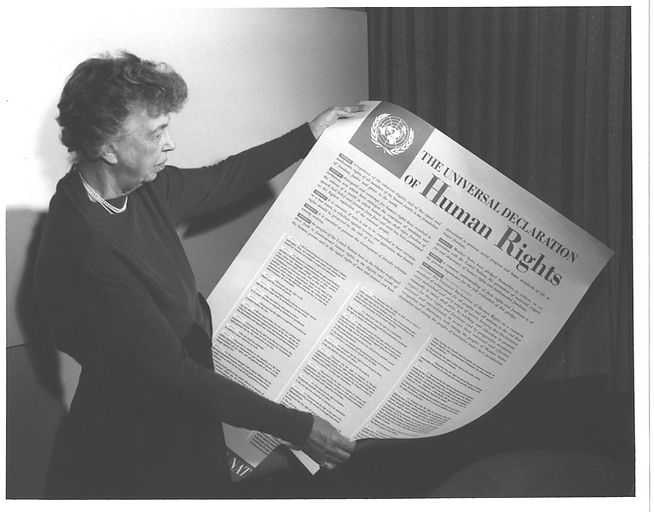
When Eleanor Roosevelt presented the Universal Declaration of Human Rights in 1948, she had finally won a long and difficult negotiation. Many nations had resisted including women among the humans protected by the document. Enough countries ultimately came around to pass the Declaration, but only with the understanding that no nation would be compelled to actually deliver those rights to women in practice.
We have lost our grasp of how recently women were excluded from the category of “fully human" and so were denied basic rights—literally, everywhere.
Nevertheless, an international consensus that included women in the Universal Declaration, even in principle, was a step that, in the long story of humanity, was utterly unique—and profound to a degree far beyond the context of the second world war. For thousands of years, women had been excluded from the category of “fully human,” and, by that reasoning, had been denied basic rights, literally everywhere.*
Of the 21 rights listed in the original Declaraton, women in most countries had only six. Indeed, the rights women were systematically denied—all over the world—included protections on the list as fundamental as “freedom from cruel, inhuman, and degrading treatment,” privacy and freedom of movement, and the right to have your own property or money. (At the bottom of this post, I have placed a pdf of the rights in the original Declaration where I have used bold face to signify which ones were denied to women in most countries at that time.)
In today’s climate, with the international order under strain, it may be difficult to imagine that the postwar nations once worked together in a sincere effort to create conditions they believed would prevent future conflict. The architects of that system saw reducing inequality—especially between the sexes—as one way to build and sustain peace. So although the Declaration itself was not legally binding, many countries, particularly the Western democracies, undertook major efforts to expand and equalize women’s rights within their own borders.
The English Common Law Countries Were Not an Exception
Most readers of this blog will be surprised that the legal systems derived from English common law presented one of the most difficult and wide-spread challenges. In the mid-twentieth century, systems built on English common law still governed roughly a third of the world’s population, including the United States, Canada, and Australia, as well as Britain itself, and a long list of other countries that had once been part of the British Empire.
By virtue of that system's design, law in each of these countries evolved slowly through precedent, custom, judicial interpretation, and philosophical doctrine, not like civil codes that could be changed simply, as in some other countries such as France. Under the old British system, the desired shift therefore required painstaking and piecemeal reform—and not just one law at a time, but one jurisdiction at a time. In the US, for instance, reform had to proceed state by state, fifty times. It took decades.
At the center of the laws governing women in these countries stood a doctrine called “coverture,” an ancient concept rooted in legal and practical traditions older than Britain itself. Under coverture, a woman lost her independent identity when she married, in effect becoming her husband’s prisoner. As the doctrine is typically summarized (quoting from William Blackstone in the late eighteenth century), coverture dictated that: “By marriage, the husband and wife are one person in law… the very being or legal existence of the woman is suspended during the marriage….”
Under the principles behind English common law, a woman lost her independent identity when she married, in effect becoming her husband’s prisoner.
Coverture was not a single law; instead, over hundreds of years, the judicial philosophy had become intertwined within a complex group of statutes governing marriage. So, even after formal coverture doctrine had begun disappearing in the late nineteenth century, the legal logic remained woven throughout family law, employment law, as well as banking, property rights, and criminal law. And that was still true the day Eleanor Roosevelt read the Universal Declaration.
We Have Forgotten How Cruel This System Was
In the common law countries, married women did not possess rights to bodily autonomy, property, income, privacy, or movement—instead, the husband had total control.
The law assumed, for instance, that marriage permanently transferred sexual consent to the husband. In real life, this meant that a man could rape his wife with impunity, not because it was legal per se, but because the law essentially granted him an exception to what would otherwise be a crime. (In the US at this time, a man could rape his wife at gunpoint in all 50 states.) The process of removing this vulnerability took four decades—in the US until 1993, in Britain until 1991, in Canada until 1983, and in Australia until 1994.
As an extension of this idea, a man owned his wife’s body so completely that he could beat her, refuse her food, lock her in her room, even torture her, within his rights under the law. The women also could not control the number of children they had, in part because they could not refuse sex.
A man owned his wife’s body so completely that he could beat her, refuse her food, lock her in her room, even torture her, within his rights under the law.
A wife owed her husband total obedience. Women were obligated to do whatever work their husband asked of them, however much, for however long, and under whatever conditions, whether it was housework and childcare—or farmwork or construction or making goods for him to sell or anything else. She was required to do all of that without pay. Like a prisoner. Or a slave.
She could not escape. Under a complex set of marital rights that, as a practical matter, functioned like rights of ownership over a person, a man also had control over his wife’s whereabouts. So, she could not leave without risking being charged with desertion. If she left, he could bring her back—and punish her accordingly. If anyone helped her, they also risked prosecution.
While the threat of violence acted as an obvious barrier to escape, economic exclusion was an equally powerful restraint. Under a set of statutes called “Head and Master Laws” or sometimes “Lord and Master Laws,” the husband had the right to control all assets and income in a household regardless of who brought them into a marriage and how. Women could not own assets, sign contracts, obtain loans, or work without a husband’s permission. (NB: The “Head and Master” laws granting husbands final control over marital property was not struck down by the US Supreme Court until 1982.)
The broader economy helped enforce these constraints. Employers in many places openly refused to hire married women at all. (These “marriage bars” did not become illegal in the UK, the US, Canada, and Australia until the mid-1960s.) Unequal pay was legal pretty much everywhere; in the US, that practice was explicitly based on the rationale that a woman must not earn enough to live on her own, but must be dependent on a man.
Banks refused even to give married women checking accounts without their husband’s signature. In Britain and America, women could not get credit cards on their own until 1974. In fact, across the English-speaking world, women’s independent access to credit remained restricted until the 1960s, 1970s, and in some cases even the 1980s.
Thus, under the legal system derived from British history, women had little realistic way to survive independently except in extreme poverty. So they married, but it was not a free choice for most. Consider the impact: in the US, the UK, Canada, and Australia, about three-quarters of all adult women were married and thus subject to the laws I’m describing.
Take note: these restrictions applied to all women, not just White women or poor women, but minority and aristocratic women, too. To illustrate, nearly all the restrictions I have mentioned also applied to Black slaves in America; however, once slavery was abolished, Black males were freed from these laws, but female slaves were not—their freedoms had to be won as women.
We Must Reframe Our Understanding of the Women's Movement
Seen in this light, the women’s movement of the twentieth century was not simply a local cultural rebellion or an uprising of privileged Western women, as critics often portray it. Instead, it is more accurately seen as a sustained international effort to extend the protections of liberal democracy and human rights to the female half of each country. It was a humanitarian effort as much as anything else, not a leftist conspiracy. And it was a voluntary, cooperative program based on the good faith expectation that equal rights was both right and beneficial, not an ideology imposed from somewhere "foreign."
Though admittedly imperfect, the effort was amazingly successful: in most countries today, the commitment to gender equality is near universal. Indeed, people who oppose equality between the sexes are not speaking for the majority, as they so often claim to be, but are such outliers that we should question their motives, rather than pacify, ignore, or succumb to them.

Indeed, today’s romanticization of “traditional marriage” should alarm us. Historically, traditional marriage was not merely a cultural preference or a lifestyle aesthetic, nor was it a manifestation of higher morality or even religious values. It was a legal structure built upon female dependency and the transfer of rights from brides to husbands.
Furthermore, despite conservative rhetoric to the contrary, recent surveys in all these countries consistently show that a return to traditional arrangements would be massively unpopular. One example: the British Social Attitudes survey showed that support for the idea that men should work and women should stay home fell to 9% in 2022. It’s easy to find similar numbers for the other countries. Just google it.
We Risk Returning to an Era Darker Than We Realize
We should be struck with a sense of trepidation every time we hear Andrew Tate or Nick Fuentes or any number of other influencers working to restore male dominance say women should go back to being subordinate to their husbands or forced to leave their jobs and return to the home—a proposal often couched as a return to the 1950s. As you can now see, if we actually did return to the 1950s, it would mean nothing less than revoking human rights for women.
And despite the current rhetoric of male grievance, men lost no corresponding rights as women gained them. To argue otherwise is to treat human rights as a zero-sum game—as though freedom and equality for one group must come at the expense of another.
If we actually did return to the 1950s, it would mean nothing less than revoking human rights for women.
None of this talk is harmless nostalgia. When the framework of history is replaced with a politically-motivated fantasy, we—as a whole world community—stand to lose more than we may realize.


A Free Calculator is especially useful when you only need to verify a few figures. Its simplicity makes it suitable for shopping, schoolwork, household budgeting, and other everyday situations where a quick and reliable calculation is helpful.
يمكن لأولياء الأمور والتلاميذ الاطلاع على نتائج التلاميذ عبر منصة مسار متمدرس بكل سهولة. يكفي استعمال بيانات الدخول الصحيحة واختيار السنة الدراسية والدورة لمعرفة النتائج التي نشرتها المؤسسة.
What a thought-provoking piece! Eleanor Roosevelt's insights on empowerment resonate deeply with me. I've often felt that embracing our potential can lead to extraordinary achievements, much like the vision behind Speed Stars—helping people unlock their capabilities in a unique way. Thank you for sharing!
A powerful and thought‑provoking read! Your clear breakdown of coverture, Head‑and‑Master laws, and the gaps in early implementation of the Universal Declaration of Human Rights delivers crucial historical context. It really drives home how fragile gender equality remains, and why romanticised visions of “traditional marriage” deserve careful scrutiny. This article gives invaluable perspective for modern‑day conversations around women’s rights. Excellent work! --RNGdle
massar service كيساعد على تنظيم الوصول إلى المعلومات الدراسية الرقمية، ولكن ظهور بعض المعطيات كيعتمد على ما تم تسجيله وتحديثه داخل النظام. لذلك إذا كانت نتيجة أو نقطة غير ظاهرة، من الأفضل التأكد من المؤسسة التعليمية قبل افتراض وجود مشكلة في الحساب.