
The Weaponization of Men


Today, the scene feels less like history than dystopian fiction.
On New Year's Eve 1969, millions of American families huddled around the living room television watching a smiling Congressman stir a big glass bowl full of blue capsules with his hand. Each capsule contained a paper slip with a different day of the year written on it.
The Congressman stopped, drew out a capsule at random, opened it with an audible snap, and read what families heard as a death sentence for every 19-year-old male born on September 14, 1951—they were all to be drafted into the US military and likely would end up in Vietnam, fighting a war that Americans and their leaders increasingly believed both pointless and unwinnable.
As the families of those first sons hugged and cried, the next government official swirled his hand in the bowl and drew a second lethal capsule. It went on for hours, until the 365th slip emptied the bowl.
By this method, every young man born in 1951 theoretically knew where he stood in the line-up. If his birthday was drawn early in the evening, it was time to bid his loved ones good-bye. If his was one of the last dates drawn, he was free to go on with his life—unless the war, already out of control, scaled up even more. Between the first and the last were the dates in the middle—those boys had a year to live on the edge of a knife.
By the end of 1970, 53% of the birthdays had been called up. Please try to imagine what this meant in lived time. I graduated from high school in 1970: more than one in every two boys who graduated with me were called. The rest were left with survivor guilt. Families, friends, girlfriends, teachers—entire communities around these boys—were traumatized.
The Vietnam draft exposed something modern societies usually prefer not to see clearly: patriarchal cultures do not merely privilege men, but weaponize them from boyhood to serve the ends of those in power, even when the goals are counter to the welfare of the citizenry. Across history, vainglorious leaders have repeatedly treated young male bodies as a kind of expendable resource—useful for war, conquest, dangerous labor, and political violence.
How do societies persuade boys to walk into this machinery? Why do their families and communities build the ramp that leads their sons into war and then stand and cheer when they go off to die?
Across time and culture, societies have treated masculinity not as a natural condition but as a difficult status boys must earn through hardness, risk, and the suppression of vulnerability. Boys are taught that fear is shameful, vulnerability feminine, tenderness weak, and obedience to hierarchy honorable. Their own willing disposability is masked as the essence of being a man.
Some societies ritualized this transformation openly—and cruelly. Spartan boys were beaten, starved, and trained for war from childhood in an institution called agoge. Like other ancient societies, Sparta pulled boys from their birth families when they were still very small, taught them the military was their family, and assigned them to mentors who trained them harshly and even required sex from them. Here, as elsewhere, boys were not only trained to suppress fear and endure pain, but to cause suffering to others—to torture, even to kill their own when commanded.
Small traditional cultures have also used outrageous torture to turn boys into “real men”—and some of these rituals continue today. In South Africa, the traditional Xhosa initiation ritual, ulwaluko, involves circumcizing pubescent boys without anesthesia or clean conditions. The boys are left to heal on their own, discouraged from seeking medical help. Infections and dehydration follow. Some die; others must undergo penile amputation. Every year, the government catalogues the casualties that come from this method of making boys into men: they number in the hundreds, even now.
Around the world and through history, other peoples have had similar rituals: the endurance trials of the Plains warriors and Australian Aboriginal initiation ordeals widening into samurai martial discipline or medieval knight training.
The language and practices have changed in modern nations; the psychological machinery has not. Modern nations developed their own softer but still powerful systems of conditioning: boys don’t cry, man up, take it like a man, never back down, your country, right or wrong. But, in the end, it’s not about courage so much as blind obedience and self-sacrifice—like the boys of my generation who went to Vietnam, regardless of how much they may have objected to that stupid, brutal war.
So, what we are today calling “traditional masculinity” is the vestige of barbaric practices meant to make warriors out of boys, in order that the vast majority of men would fight for the interests of elites at their behest—and their families would let it happen.
Whether the man brought up with these expectations goes to war or not, the impact on him is profound—and not in a good way. Social scientists have studied the effects of the traditionally masculine ideal for decades. They define “traditional masculinity” just as popular discourse does—strength, reticence, stoicism, contempt for the feminine, willingness (and ability) to use force, and, above all, dominance. Using these terms as variables, these scientists then correlate the outcomes of men who hold these ideals.
If you step aside from the value judgment we have all been taught—such “real men” are to be admired—and just look at these data, the damage that men endure as a result is painfully visible.
As you might expect, the first noticeable effect of the old masculine ideal is to build a man whose temper is quick and whose propensity for violence is stronger than it is for other men. That reality pushes them disproportionately into day-to-day conflicts from bar fights to domestic violence. But it goes much farther: traditionally masculine males are shockingly overrepresented in every prison system in the world. Such men also fill the memberships of antisocial groups from biker gangs to urban drug rings. In comparison, men who do not identify with this ancient ideal virtually never show up in such settings.
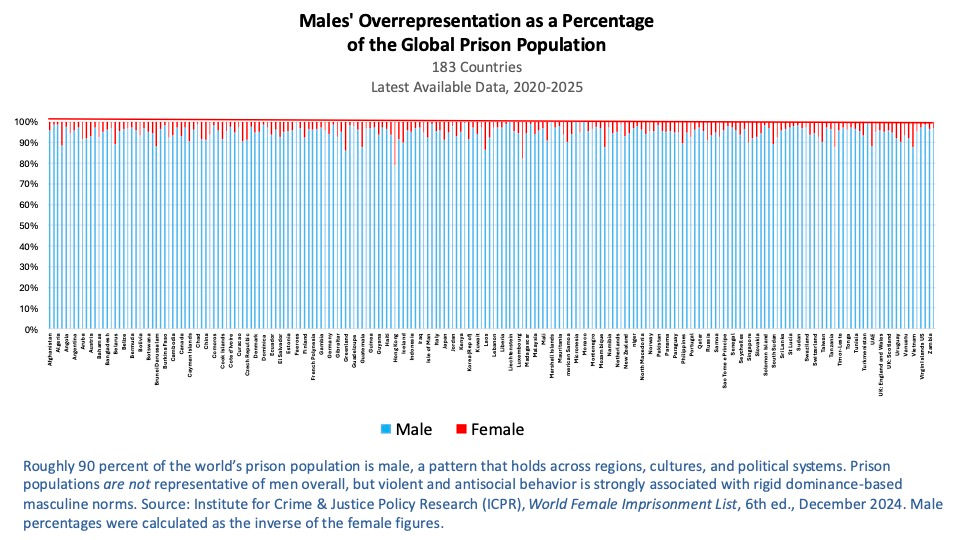
The distress male conditioning causes in their interior lives is heart-breaking. These men are constantly torn between their anxieties about living up to an extreme ideal and their fear of failure. Many struggle between the harsh demands of the ideal and everyday compassion. The inner turmoil leads to higher levels of substance abuse and suicide among this group. They are very lonely, unhappy, aggrieved. They take reckless risks from daredevil stunts to get-rich-quick schemes. And you can imagine the circular effect that occurs between the interior tensions and outward aggression: in clinical circles, aggressive behavior is a recognized attribute of the mental health damage; in police stations and prisons, the observable manifestation is the thin skin and hair-trigger temper, or the overblown brooding, that leads to violent crime.
Men like this have difficultly forming and maintaining relationships of all kinds. They have few male friends and are seldom very close to any of their “bros.” They have trouble getting dates and when they do find someone, they are more likely to initiate conflict, to refuse communication, and to devolve into abuse. They also more often cheat on their partners and get divorced.
Fearing a cold and distant, but easily angered and harshly punitive father, children in such homes fail to thrive. They do not do well in school nor in social relations with their peers. The boys, unable to successfully regulate their emotions, are prone to delinquency, often expelled or arrested. The girls have low self-esteem, restricted dreams for themselves, and a high tolerance for coercion by others. It's easy to see how these family patterns replicate themselves from generation to generation.
In sum, traditionally masculine men are miserable and so is everyone close by them.
These patterns do not remain confined to individual lives. We should be aware and concerned about the macro-level effects, which are easily visible in data collected (in volume) by independent world institutions.
When entire political cultures glorify hard masculine dominance, the consequences become societal. All over the world—right now—we see a rise in authoritarianism heralded by the imagery and language of militarized maleness. Hypermasculine brutes intent on total power recruit these perpetually disgruntled males into their service and suddenly it’s all jackboots and camo, underscored by online rage promoting hate in the name of manhood. This phenomenon has brought down democracies at an unprecedented rate for the past 20 years and is only building more steam.

Nations where warrior masculinity still sets the tone respond to every challenge with violence, killing first and claiming they will talk later. But that's not all. Wherever this ancient model of manhood infuses political culture, the direst consequences are in plain sight: not only higher levels of conflict and crime, but trafficking, poverty, disease, and hunger. There is no room for nostalgia in these data, only measurable social damage.
In short, the old masculine ideal is not uplifting or stabilizing. It is only good for the one thing it was historically purposed to do: wreaking violence on others. There is no way that the self-appointed public experts calling for its return have done their homework: the big scientific societies around the world have consistently found that traditional masculinity cannot be the solution because it is the problem.
Apologists nevertheless claim that abandoning the old ideal has produced a generation of weak, feminized men. And, indeed, the majority of men today, particularly in the Western democracies, no longer subscribe to the dominant male model at all.
But no one seems to be asking the obvious question: if the majority of males no longer endorse traditional masculinity, what do they think an ideal man is? Put differently, what if we are not witnessing the collapse of masculinity, but its reinvention?
Men who reject rigid dominance norms consistently show healthier psychological profiles, stronger relationships, greater emotional resilience, lower levels of violence, and more engaged fatherhood—and the societies where they are in the greatest numbers are the most stable, best educated, healthiest, and most prosperous countries in the world.
So, despite endless ridicule from defenders of the old order, these men are not failures. They appear to be quietly building a form of masculinity far more conducive to human well-being.
These "new men" do have a coherent profile in the data. It's important to know what that profile looks like, precisely because they are now the majority, especially among the young. But that’s too big a topic to continue with here. Please “turn the page” to the next blog: “The Boys Who Refused to Become Their Fathers.”
Abbreviated Sources
Research on traditional masculinity and “precarious manhood” includes work by Jennifer Bosson, Ronald Levant, James Mahalik, and the American Psychological Association’s Guidelines for Psychological Practice with Boys and Men.
International affairs data, as well as scientific findings from several fields, synthesized by Valerie Hudson and her colleagues.
Data on incarceration, violence, suicide, and workplace fatalities are drawn from sources including the FBI, Bureau of Justice Statistics, CDC, WHO, and U.S. Department of Labor.
Cross-national data on democracy, conflict, trafficking, and gender inequality include the V-Dem Institute, Global Peace Index, the World Economic Forum's Global Gender Gap Report, the United Nation's Human Development reports, the Social Institutions and Gender Index (SIGI) produced by the Organization of Economic Cooperation and Development (OECD), and related international datasets.


Users often want to understand the available sections before exploring an online gaming platform. Jalwa Games is searched by people looking for general information about the platform and its gaming-related options. New visitors can review the available details and understand the basic navigation before moving ahead. Account credentials should also be kept private while using any online platform. Anyone researching jalwa games can start with the basic information and gradually become familiar with the different sections.
أصبحت منصة مسار من الخدمات الرقمية المفيدة التي تساعد التلاميذ وأولياء الأمور على متابعة المعلومات الدراسية بسهولة. أكثر ما يعجبني فيها هو توفر الخدمات في مكان واحد، مما يجعل الوصول إلى البيانات التعليمية ومتابعتها أكثر تنظيماً ووضوحاً للمستخدمين.
While I agree with your points about masculinity's toxic aspects, I wonder if we might also explore ways to redefine strength in a doodle baseball more positive context.
The daily format of scrandle works really well for a quick browser game. I like having one fresh challenge to come back to rather than burning through dozens of rounds in one sitting.
分かりやすい内容で、ゲームの面白さについて自然に理解できました。シンプルながら奥深いゲームは、幅広い人に楽しんでもらえると思います。プラットフォーム系ゲームが好きならGeometry Dash もおすすめです。音楽とステージの組み合わせが特徴で、新しいレベルに挑戦する楽しさがあります。