
We Were Not Born Into Patriarchy

Recent archaeology shows patriarchal systems are a late-breaking development
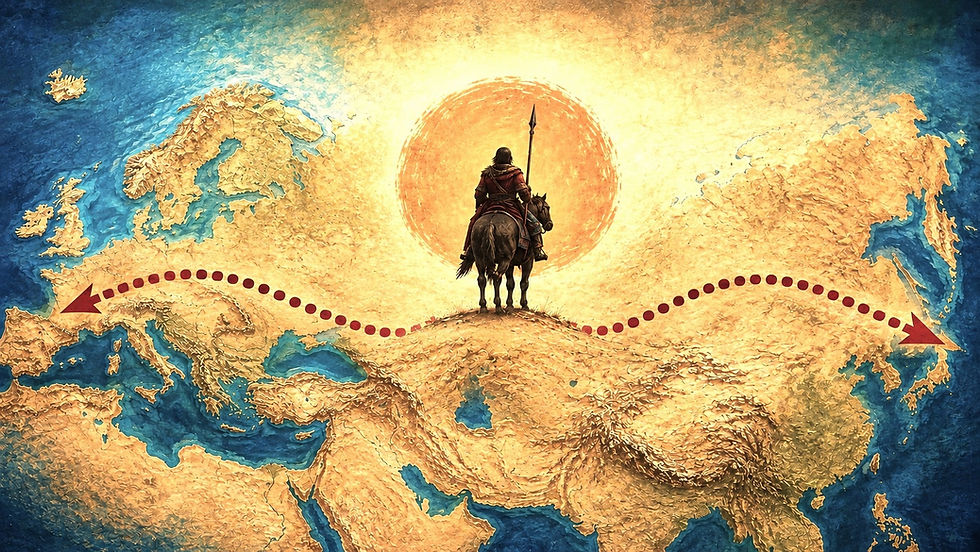
Five thousand years ago, a swarm of armed warriors erupted from the steppes of eastern Europe. Some of the horde went west and the others rode east. Wave after wave, they swept across the steppes and eventually overwhelmed the human societies from the British Isles to South Asia, from Scandinavia to the Mediterranean.
The expansion of the Yamnaya—so named by the archaeologists, historians, and anthropologists who study them—was the first known war of conquest in human history. The culture that spawned this remarkable aggression was also the world’s first full-blown patriarchy.
What made these people, alone among the humans across that landmass, suddenly expand so swiftly, thoroughly, and aggressively? The evidence points to an answer: all four markers of a patriarchal political system had—for the first time in human history— emerged all in one place. The conquest came almost immediately after that (with “immediate” being, in archaeological terms, within a few centuries).
Those four markers of full-blown patriarchy are:
(1) a group of men determined to dominate at scale
(2) weaponization of the rest of the male population
(3) men controlling women’s sexual availability for their own purposes and
(4) unequal access to resources by sex.
Before this momentous event, Homo sapiens evidenced group violence on the level of your average bar fight, as well as a few raids, but nothing like the Yamnaya’s large-scale, organized effort to dominate and destroy other human settlements. There were also societies that showed evidence of gender equality. Before the steppe expansion, many Neolithic communities show no detectable material disadvantage for women at all. Aside from the occasional evidence of chiefdom in grave goods, the pre-Yamnaya settlements were egalitarian.
Importantly, none of the other existing societies had the four markers at once and none had engaged in the kind of aggression that would characterize human history for the next five millennia.
Since our kind has now survived for 300,000 years, the 5,000 year window since the Yamnaya expansion represents less than 2% of our time as a species (the math is 5,000/300,000 = 1.67%). So, the evidence surrounding the emergence of the Yamnaya shows definitively that Homo sapiens hasn’t always been a male dominant species.
Because they had never had to counter a militarized force intent on dominance, the populations in the invaders’ path were easily overwhelmed. The multitude from the steppes destroyed villages and farmland, killing the men while raping, capturing, and forcing “marriage” on the women.
How do we know the Yamnaya enacted sex-biased violence? Because they left behind an astonishing genetic imprint. In today’s Spain and Portugal, incoming steppe-derived people ultimately supplied only about 40% of the population’s overall ancestry—but nearly 100% of the Y chromosomes. What this means: local men were pretty much wiped out, leaving Yamnaya men to impregnate local women. Indeed, all across Europe, the genetic imprint of the Yamnaya invasion remains common—often dominant—even today.

Note: Approximate modern frequencies of R1b-M269 and closely derived paternal lineages associated with the Bronze Age steppe expansion. These percentages measure surviving male-line ancestry, not total Yamnaya ancestry. Sources: Balaresque et al. 2010; Myres et al. 2011; Olalde et al. 2018; Solé-Morata et al. 2017; Luis et al. 2021.
Maybe because I taught at Oxford for ten years or maybe because Americans tend to think of their heritage as British, I was particularly struck when I learned that about 90% of the entire gene pool of Britain was replaced within just a few hundred years. Think of it: the population descended from the Neolithic farmers who built Stonehenge was demographically erased almost completely.
And the legacy is still visible. The Bronze Age steppe-derived Y-chromosome lineages that came to dominate Britain and Ireland remain extraordinarily common today—especially in Ireland, Wales, and western Britain, where their presence ranges from 70 to 90%.
This is not what peaceful family migration looks like. Rape, capture, and forced marriage are the obvious mechanisms by which conquest produces such a pattern—that, along with the timeframe, just does not fit mutual respect and affection as a major motivator.
War kills and maims, but it also consistently leaves behind destruction that harms populations long afterward—by reducing the capacity to produce food, disrupting trade and migration routes, displacing communities, and spreading disease. The Yamnaya invasion was not exceptional in this regard. Militarized conflict can also magnify an existing disease burden or introduce new contagions. The Yamnaya expansion coincided with just such an epidemiological upheaval: their migrations helped spread early strains of Yersinia pestis across Eurasia—the plague bacterium whose later descendants would devastate Europe in the Black Death.
In addition to their genetic takeover, the Yamnaya imposed their militaristic, authoritarian, misogynistic social structure on the communities they encountered. This, too, would have supplanted everything there before—specifically because the ethic behind the expansion was conquest, not mere acquisition of resources or access to trade routes.
Conquest is not just migration into new territory. It presupposes a willingness to override other people's claims: to land, resources, autonomy, and often bodily security. Once that ethic is operating, replacing or subordinating local institutions is not an accidental side effect; it is part of how conquest works.
Can we say “the rest is history”? The Yamnaya did not invent every later patriarchal institution, nor did every militarized society descend directly from them. Even the Yamnaya expansion unfolded somewhat differently on the eastern side—just as fast and direct, but with a weaker long-term genetic impact.
We can see, though, that, within a thousand years, the dispersal of patriarchy’s four core attributes (warlike, trading women against their will, super hierarchical, severe resource inequality) reached across Eurasia, leaving that distinctive profile everywhere. From Sargon’s Akkad to Homer’s warrior kings, from Assyria and Sparta to Rome, the Vikings, and the Mongols, the costumes and weapons changed. The political grammar endured.
Patriarchy—again, with the same four pillars all at once—appeared independently on other continents, but later. Working from the evidence available, we can identify examples in Africa, the rest of Asia, the Americas, and, with qualification, Australia. Four-pillar African patriarchy appears by the early Iron Age in southern Africa, among Bantu-speaking people, somewhere between about 650 and 1050 CE. In the Americas, the clearest early case seems to be the Maya, by about 600–750 CE. And in the far east, beyond the reach of Yamnaya-descended populations, the Shang dynasty is the earliest Chinese case in which all four pillars can be seen together, roughly 1600–1046 BCE. In all of these cases—the Shang, the Maya, and the Bantu—conquest and territorial expansion followed. Big wars.
When the Europeans first made contact with the Australian aboriginal groups, some already had the the four markers, showing that patriarchy manifested independently of Eurasian contact there, too. For instance, among the Arrente of Central Australia, nineteenth-century ethnographers recorded all four elements together: male political and ritual authority, organized armed violence, institutional allocation of women in marriage, and sex-based restrictions on access to important foods. So, we know patriarchy evolved independently because it was already there when the Europeans arrived. However, we do not know what date the first patriarchal political system appeared down under because the evidence is too thin and we can’t locate a conquest for the same reason.
Contrary to the conventional wisdom among feminists and lefties, therefore, the European imperialists did not bring patriarchy to the rest of the world—it was, for sure, already there. And this ominous development happened too long ago to be blamed on capitalism.
It’s a logical next step to imagine that, once there was a full-on patriarchy bent on power in a region, it would only be a matter of time before peaceful, egalitarian arrangements would be forced to arm themselves or be wiped out by aggression. Two illustrations. The Cucuteni-Trypillia were on the nearby western border of the steppe when the Yamnaya left home. Those people suddenly concentrated their population and built walls, ramparts, and the like. We can guess why.
Much later, a poignant example of the opposite behavior occurred. When 900 Maori invaded the Chatham Islands in 1835, the people there had a law of peace prohibiting warfare. In the face of the assault, the Moriori elders decided not to abandon the peace law. The invaders killed one-sixth of their population and enslaved the survivors. So, the Moriori were not biologically exterminated, but as an autonomous society they were catastrophically crushed precisely because they refused to become a warrior society in response to invasion.
No surprise, then, that over the millennia following the Yamnaya conquest, patriarchal societies expanded until they dominated every major population center and political system on earth, progressively absorbing, displacing, or surrounding societies that were organized differently
We can infer further that, once all the cultures in an area were fully patriarchal, warfare among them became recurrent and endemic. For centuries, European states fought one another with remarkable frequency. Rulers and their councils compelled men to serve as soldiers and financed their wars through taxes and requisitions that reached deeply into the general population. For much of European history, ordinary people lived under the recurring economic and physical burdens of warfare, even though they themselves had no say in whether wars were begun in the first place—or even knowlege of why the wars were being fought. Had they known, they might have been unconvinced of the necessity for battle, since those wars, like all the others, were being fought over the hegemony of one aristocratic lineage or some self-aggrandizing scheme begun by a king. Hardly worth dying and killing for, IMHO.
Today, every country on the face of the earth has the same four markers that made the Yamnaya distinctive: power-hungry leaders, weaponized men, trading in women, and economic inequality. Just as it happened 5,000 years ago, patriarchal aggression leaves behind death, rape, hunger, disease, and economic devastation. Yet we tell ourselves patriarchy is natural, inevitable, and even good for us, when none of those things are true.
Select Bibliography
Anthony, David W. “The Yamnaya Culture and the Invention of Nomadic Pastoralism in the Eurasian Steppes.” In The Indo-European Puzzle Revisited: Integrating Archaeology, Genetics, and Linguistics, edited by Kristian Kristiansen, Guus Kroonen, and Eske Willerslev. Cambridge: Cambridge University Press, 2023.
Haak, Wolfgang, Iosif Lazaridis, Nick Patterson, Nadin Rohland, et al. “Massive Migration from the Steppe Was a Source for Indo-European Languages in Europe.” Nature 522 (2015): 207–211. https://doi.org/10.1038/nature14317.
Lazaridis, Iosif, Nick Patterson, David Anthony, Leonid Vyazov, et al. “The Genetic Origin of the Indo-Europeans.” Nature 639 (2025): 132–142. https://doi.org/10.1038/s41586-024-08531-5.
Lee, Richard B. “Hunter-Gatherers and Human Evolution: New Light on Old Debates.” Annual Review of Anthropology 47 (2018): 513–531. https://doi.org/10.1146/annurev-anthro-102116-041448.
Olalde, Iñigo, Selina Brace, Morten E. Allentoft, Ian Armit, Kristian Kristiansen, Thomas Booth, Nadin Rohland, et al. “The Beaker Phenomenon and the Genomic Transformation of Northwest Europe.” Nature 555 (2018): 190–196. https://doi.org/10.1038/nature25738.
Olalde, Iñigo, Swapan Mallick, Nick Patterson, Nadin Rohland, Vanessa Villalba-Mouco, Marina Silva, Katharina Dulias, et al. “The Genomic History of the Iberian Peninsula over the Past 8000 Years.” Science 363, no. 6432 (2019): 1230–1234. https://doi.org/10.1126/science.aav4040.
Narasimhan, Vagheesh M., Nick Patterson, Priya Moorjani, Nadin Rohland, et al. “The Formation of Human Populations in South and Central Asia.” Science 365, no. 6457 (2019): eaat7487. https://doi.org/10.1126/science.aat7487.
Sikora, Martin, Elisabetta Canteri, Antonio Fernandez-Guerra, Nikolay Oskolkov, Rasmus Ågren, Lena Hansson, Evan K. Irving-Pease, et al. “The Spatiotemporal Distribution of Human Pathogens in Ancient Eurasia.” Nature 643 (2025): 1011–1019. https://doi.org/10.1038/s41586-025-09192-8.
Singh, Manvir, and Luke Glowacki. “Ecological Variation and Institutionalized Inequality in Hunter-Gatherer Societies.” Proceedings of the National Academy of Sciences 118, no. 13 (2021): e2016134118. https://doi.org/10.1073/pnas.2016134118.


Comments